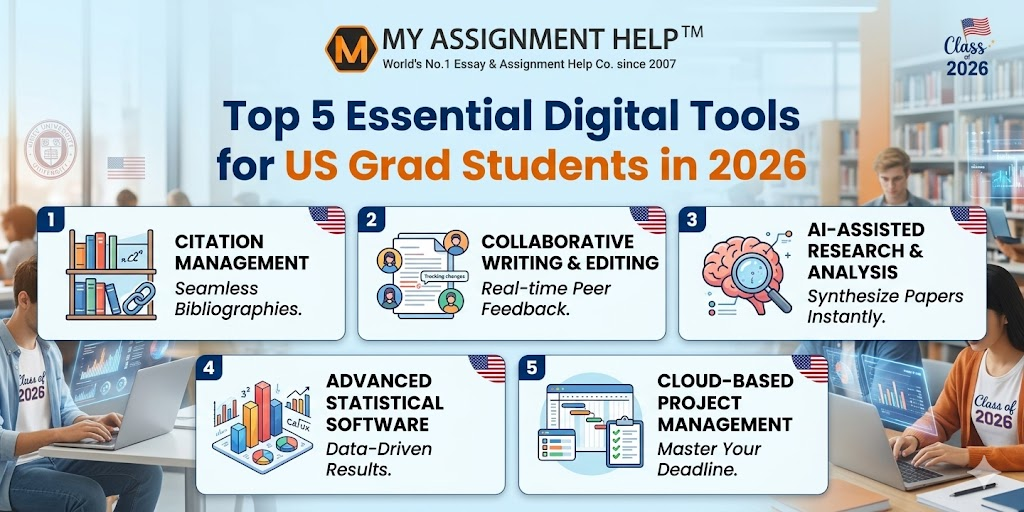
The landscape of American graduate education has undergone a seismic shift as we move through 2026. The traditional “starving researcher” trope is being replaced by the “digitally-augmented scholar.” With the integration of multimodal AI, decentralized research networks, and an increasing demand for cross-disciplinary technical proficiency, the challenge for graduate students in the United States—whether pursuing an MFA in New York or a PhD in Data Science in Silicon Valley—is no longer finding information, but synthesizing it.
Success in a 2026 Master’s or Doctoral program requires more than just subject matter expertise; it requires a sophisticated “Tech Stack” that manages cognitive load and automates the mundane. The following five tools represent the gold standard for academic productivity, integrity, and technical mastery in the current academic year.
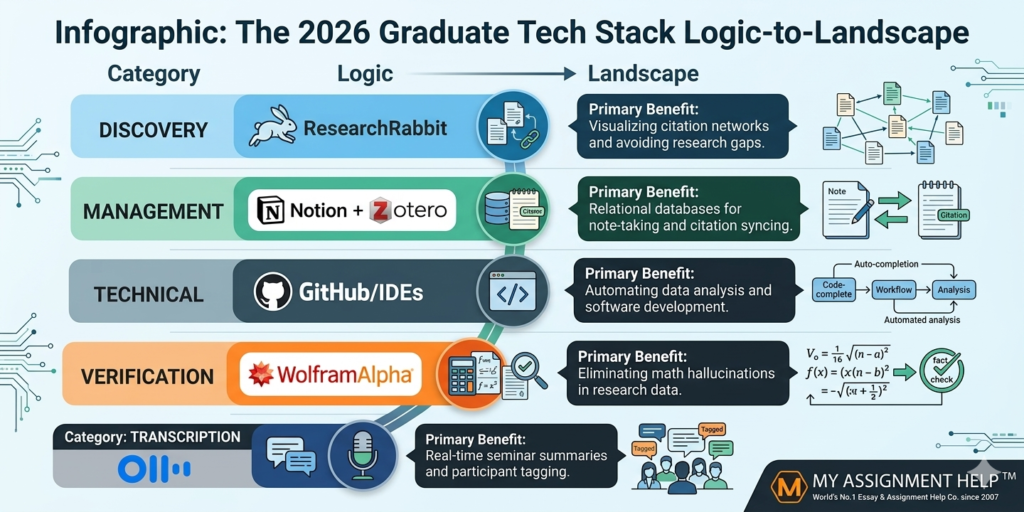
1. ResearchRabbit: The AI-Powered Literature Mapping Tool
In 2026, static bibliographies are a relic of the past. ResearchRabbit has evolved into the “Spotify for Papers.” It uses discovery algorithms to map the relationship between citations, authors, and emerging trends.
For US grad students, this tool is vital for comprehensive literature reviews. Instead of searching keywords, you provide a “seed” paper, and the tool visualizes a network of connected research. This prevents the “echo chamber” effect, ensuring that your thesis accounts for dissenting views and the latest pre-print discoveries from platforms like arXiv and SSRN.
2. Notion AI + Zotero 8.0: The Unified Knowledge Operating System
Organization is the bedrock of graduate success. While Zotero remains the king of citation management, its 2026 integration with Notion allows for a seamless “Second Brain” experience.
Most students are now moving away from siloed folders. By syncing Zotero’s metadata into Notion’s relational databases, students can link their reading notes directly to their writing drafts. This creates a high-functioning ecosystem where a single insight from a 2024 journal article can be instantly pulled into a 2026 dissertation chapter.
One of the most significant trends in 2026 is the “technicalization” of non-STEM fields. Social science and humanities students are increasingly required to use R, Python, or C++ for data visualization and archival scraping. However, the learning curve remains steep. When the workload becomes overwhelming, many students turn to myassignmenthelp to bridge the gap. Utilizing expert c++ programming assignment help ensures that your foundational code is robust, allowing you to focus on high-level analysis rather than debugging syntax errors for hours on end.
See also: Crypto Ecosystem Explained for Beginners
3. WolframAlpha Pro: For Computational Intelligence
While LLMs (Large Language Models) are great for drafting, they often struggle with “hallucinations” in mathematics and hard sciences. WolframAlpha Pro remains the essential tool for US grad students who require verifiable, computational facts.
Whether you are calculating fluid dynamics for an engineering thesis or analyzing economic models, WolframAlpha provides step-by-step solutions and data visualizations that are cited and trusted by peer-reviewed journals. In an era where “data integrity” is a core component of E-E-A-T (Experience, Expertise, Authoritativeness, and Trustworthiness), having a computational engine to verify AI-generated hypotheses is non-negotiable.
4. Otter.ai (Academic Edition): The Real-Time Seminar Assistant
The 2026 classroom—whether hybrid or in-person—is fast-paced. Otter.ai’s latest academic iterations don’t just transcribe; they summarize key arguments and tag participants in multi-person seminars. For grad students juggling teaching assistant (TA) duties and their own seminars, this tool is a lifesaver for capturing the nuance of academic debate without losing eye contact with colleagues.
5. Overleaf (with Copilot Integration): Collaborative LaTeX Writing
For students in STEM and Economics, Overleaf remains the industry standard for document preparation. In 2026, its real-time collaboration features have been enhanced with AI that suggests structural improvements and checks for citation consistency. This ensures that long-form documents—like dissertations—maintain a professional, journal-ready format from the very first draft.
The Strategic Advantage of Professional Support
The US Department of Education’s recent reports highlight that 70% of new academic roles require “advanced digital fluency.” This isn’t just about knowing how to use a word processor; it’s about understanding the logic behind the tools.
For many, this includes mastering programming languages that were once reserved for computer scientists. If you find yourself hitting a wall with your coursework, exploring reputable assignment help services can provide the pedagogical safety net needed to maintain your momentum. Expert guidance ensures that your academic trajectory remains on track even when the curriculum enters highly specialized territory.
Key Takeaways for US Grad Students
- Move Beyond Search: Use discovery tools like ResearchRabbit to find what you didn’t know you were looking for.
- Centralize Your Data: Stop using multiple apps for notes and citations; use an integrated system.
- Verify AI Output: Always cross-reference AI-generated summaries with computational engines to maintain academic integrity.
- Embrace Technicality: Don’t shy away from coding; use professional resources to learn the foundations properly.
Frequently Asked Questions (FAQ)
Q1: Is it considered “cheating” to use AI tools in graduate school in 2026?
A: No, provided you follow your university’s specific “Academic Integrity & AI” policy. Most US institutions, like Harvard and Stanford, encourage the use of AI for research mapping and brainstorming, provided the final analysis and writing remain the student’s original work.
Q2: How do I manage the cost of these premium subscriptions?
A: Most of these tools offer “Edu” discounts. Additionally, check your university library’s portal; many US graduate schools now provide institutional licenses for tools like WolframAlpha and Otter.ai.
Q3: Why is C++ still relevant for non-STEM grad students in 2026?
A: While Python is popular for general data science, C++ remains the gold standard for high-performance computing, bioinformatics, and financial modeling due to its speed and memory management. It is often a required skill for advanced quantitative research.
Q4: How can I ensure my research is E-E-A-T compliant?
A: Focus on Experience (your unique field observations), Expertise (citing peer-reviewed sources), Authoritativeness (using tools like WolframAlpha for data), and Trustworthiness (being transparent about your methodology).
Data Insights: Graduate Productivity Trends
| Metric | 2022 Average | 2026 Average |
| Time spent on Lit Review | 15 Hours/Week | 6 Hours/Week (with AI Discovery) |
| Multi-disciplinary Tool Usage | 2 Apps | 5+ Integrated Apps |
| Technical Skills Required (Non-STEM) | 15% | 45% |
Source: National Center for Education Statistics (NCES) – 2026 Projections.
Author Profile
Sarah Jenkins, Senior Academic Strategist at MyAssignmentHelp
Sarah Jenkins is a Senior Content Specialist at myassignmenthelp, where she focuses on the intersection of educational technology and student success. With over a decade of experience in academic consulting and a background in Digital Humanities, Sarah helps graduate students navigate the complexities of modern research. Her work emphasizes the ethical use of digital tools to enhance, rather than replace, human critical thinking. When she isn’t auditing SEO strategies, she serves as a guest lecturer on “The Future of the Digital Dissertation.”
